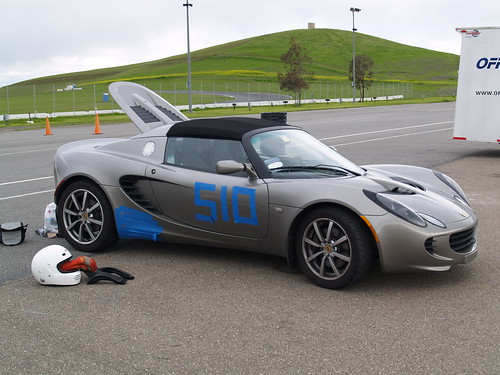
One of the highlights of the 2008 West Coast Lotus meet were the time trials that were held at the go-kart track of Jackson County Parks facilities. You often hear that the Lotus handles like a go-kart but this was the first time that I got to drive my Elise on an actual go-kart course. Our run format consisted of running 3 back to back laps on the outside of the track to count as one single timed run. It was an interesting day and we got to to run the first session in the dry before the rain came down creating a very wet second session.The following video combines in-car and external footage of my first wet run of the afternoon. Major thanks to Rob and Jen from Dietsch Werks for taping the run from the outside.
Since my R-compound tires were completely slick I had to swap to my AD-07 street tires for the first time in six months. The combination of skinny tires, street compound and wet surface meant that I had no grip and I almost went off while braking for turn 1 (I was later riding with someone who shall not be named when we actually went off at the same spot ). I make the turn with about six inches to spare and am pretty cautious and slow waaaay down for turn two only to find the rear end wants to fishtail on the exit. Turn 3 went much better but the lack of front-end bite at turn 4 lead to a few NSFW comments. At this point I slowed down even further and tiptoed my way around the course for the rest of the run. We later found out that the county had repaved about half the track which meant that the course had sections with both old and new asphalt which account for the wide variance in the grip levels at the turns. Turns 1 through 4 had the lowest grip and you had to tiptoe through them before getting on the throttle for the rest of the course.
The next video is incar from my final run in the dry. The lap is much better and doesnt have too many mistakes apart from a missed shift on the start of lap 3 – I believe it ended up being the second fastest Lotus time of the morning.
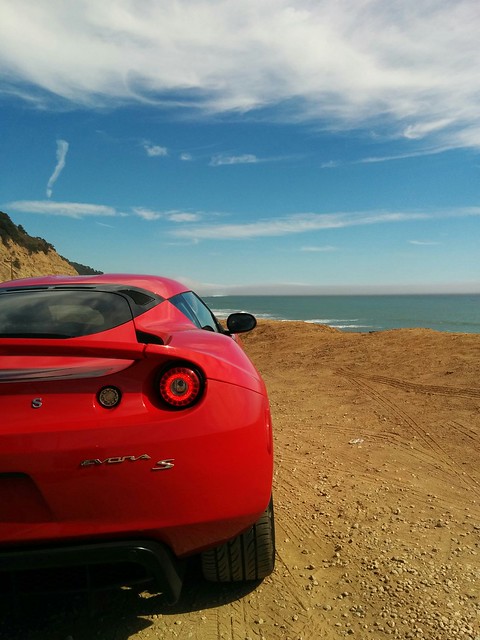
One of the photos I took of my dust covered Elise has been used in an SCCA RallyCross ad in the July Issue of SportsCar magazine. And no I do not RallyCross my Elise – the dirt was a result of my Reno-Fernley spin. It was taken with a Nokia N95 and looks remarkably good in a full page print advert (proof image here).
This happened a few weeks ago but I only just got around to blogging it
I finally got around to editing and uploading some of the video* I recorded during my last trackday. This was the first time I was using the Nokia N95 and I had high expectations from the high-rez camera. As you can see over here the video quality is dramatically better than my past recordings from the N73. I have been planning on getting a ChaseCam PDR setup for a while but now that I can get such excellent video from the phone I think I will stick to my homebrew cellphone setup. There are still some issues with vibration on the high speed straights but I am confident that I can fix that adding a layer of padding (tissue/cloth) to the phone before taping it to the car.
*This video is only to show quality of the recording – the driving still needs some work
I was at the NCRC trackday at Reno-Fernley Raceway last weekend when I got some first hand experience of what happens in a high speed spin. I was coming down the front straight at well over 100 mph and slowed slightly to take the esses that make up turn 1. Now on the track map they may look like fairly severe turns but in actual fact you just lift a little bit to settle the car at the end of the straight before flooring it though S bends. On this particular lap I came in a little hotter than on my previous runs and just after i made it though turn 1 (but before 1A) the back end came around and I flew off the track at 95 mph.
People have asked me if my life flashed before my eyes but in reality the only thought that went through my head was “Please don’t flip!” . The car was surrounded by a massive dust cloud which meant that I had zero visibility – I had the sensation of spinning and slowing down but had no clue as to which direction I was heading. As is standard practice during a spin I “put both feet in” (hit the clutch and brake) to ensure that the car has a predictable trajectory so that other drivers can avoid it. It probably took about 30 sec to a minute for the dust to settle but it felt like an eternity as I had no idea where on track I was or what the condition of the car was. Once the dust settled I found that I was in the sand/gravel trap about 50-60 feet from the left edge of the track and having done at least one 360, pointing in the correct direction. I started up the engine but since I couldn’t actually see much of the road in front of me I backed the car up about 10 feet. Moving the car turned out to be an excellent idea because the dried grass under the engine bay had caught fire and when I moved I could see that the spot I had stopped in was actually burning (maybe 4-6 inches on flame). I then waited for a couple of the cars to pass before slowly driving through the gravel trap and rejoining the circuit. The car initially felt fine but as soon as I took a right turn I found that the steering was pulling to the left. While I initially feared suspension damage, by the time I got to the pits I was pretty sure that it was a flat in my left front tyre.
Examining the wheel in the pits showed that the flat was due to the tyre popping off its bead rather than an actual puncture. I borrowed a jack and pulled off the tyre before inflating it and reseating the bead. Luckily the wheel had no damage and the tyre held air with no leaks. I also checked for suspension damage but thankfully everything was solid. Now that the my greatest fear was passed, I examined the rest of the car for damage and amazingly the only other issues were a broken mirror on the drivers side and some minor paint chipping on the drivers door. The car itself was absolutely filthy with a thick layer of dust coating every square inch of the interior and exterior. I knew that going into the gravel trap would be dusty but never expected it to be this bad – my passenger commented that it felt like a dump truck had poured a load of dirt into the cabin. I drove into local car wash during the lunch break and washed the exterior of the car before spending a small fortune on vacuuming the dirt out of the interior. In about 2 hours time the car was most back to normal and looked like merely a dirty car rather an absolute write-off.
Post Mortem
Since this was my first track day with a DL1 data logger, I actually had detailed logs to help me diagnose what exactly went wrong in the corner. The first diagram shows the line I took through turn 1 while the second is a graph showing the speed and longitudinal G force plotted against distance. The red line is the lap I went off on and the black line is data from my previous flying lap. The first thing I noticed that my speed down the front straight was significantly higher than on that lap (114 mph Vs 107 mph). This meant that when I lifted to set the car up for turn 1 it took longer to get to the right speed and I ended up going into the corner a bit too wide (figure 1). As a result of this the car got a little loose through the turn and I instinctively lifted of the throttle just a tiny bit (figure 2). This created a classic case of lift-off oversteer where the weight transfered to the front wheels causing the rear to lose traction and come around. I have experimented with lift-off oversteer before and even use it at autocross to rotate the car but this was the first (and hopefully the last) time this has happened to me at such a high speed. It was a pretty scary experience and happened so fast that I had absolutely no chance of catching it – all I could do was hold on and hope for the best.
In the end I was extremely lucky to walk away from a near triple digit spin with nothing more than a broken side mirror and a very dirty car. Having the DL1 was extremely useful in diagnosing the issue (especially since I don’t recall lifting but the data doesn’t lie) and gave me more confidence about going back onto the track. The next day I was back on the track and while I was initially a bit gun shy of turn 1, by the end of the day I was taking it at regular speed. All in all it was a very educational experience and reinforced the need to follow the mid-engine car drivers mantra – “Don’t lift” .
Update: I’ve posted this as an EliseTalk thread that is getting some interesting feedback and ‘confessions’
I am a great fan of in-car video during HPDEs. It is a great tool to analyze your performance and see how different lines have affected you laptimes – works even better when you have a DL1 or some other data logger. In-car video is also a great way to give people an idea of what its like to track a car and maybe even understand you keep grinning from ear to ear after each event.
However when I see the average setup (for an Elise) at an HPDE it looks to go one of two ways
1) The full on treatment: This is a full on video system that gives you the best quality video and audio and will usually record several hours without any issues. Some of the equipment that this requires is
This kind of a setup will give you close to pro level AV and is the next best thing to actually sitting in the car. However the total price tag of around $1200 bucks (not including harness installation) is usually out of the price range of all but the most avid track junkies.
2) Track video lite: This setup tries to replicate the quality of the track video but uses consumer grade electronics and usually does not leave any permanent alterations to the car. The parts list includes
Solid state Camera: $300-$500 for either commercial point and shoot camera or a consumer camcorder
Solid state memory: ~$100 for a 4 GB CF card
Portable storage: Since these cameras fill up memory very quickly you will have to download the video between sessions to either a laptop or a storage solution like the Wolverine ($150)
This system is considerably cheaper (~$550 excluding storage) and is probably the most popular HPDE setup. The quality is pretty decent (800 x 600 or 640 x 480) though people say that the vibration affects the image stabilization systems on these cameras and track life is only about 2 years. Additionally you have to use some sort of storage system to suck the video out between lap sessions and that can get tiresome. While you can mix and match components to get a setup for < $500, it's still quite pricey for someone who is still deciding how much to invest in track equipment.
A looking for a cheaper alternative
This got me thinking about possible ways to record video for free to see how useful it is before actually investing in a full on setup. One of the most ubiquitous technologies to emerge in recent years has been the cameraphone which invariably has a video mode as well. Now off course the video quality of the cameraphone is dependant on the device, but newer devices usually have at least 2 megapixels and can use large memory cards to store virtually limitless video. Phones are built to withstand rougher use than a camera (they go through several types of drop tests) and being solid state they are less affected by vibration. I then decided to build my own in-car video setup using a cellphone.
My Setup
The latest device that I have been playing with is the Nokia N73 which has a 3.2 megapixel camera and can hold 2GB miniSD card. It records video at a resolution of 320 x 240 and saves it as mp4 files which can be read on any PC. Since an hour of video only takes ~300 MB, I knew that a 2GB would be more than enough to record video for an entire track weekend. I didnt mind spending the money (~$40) on the card because I knew that even if I didn’t use it for video I would definitely use it to store music on my phone.
The mounting device was little trickier, the cameraphone has no mount points on it which meant that I couldn’t use any of the traditional mounting systems (would have been out of my budget anyway). However while looking at the interior of the car I realized that the back window of the Elise is perfectly vertical and if I could attach the phone to the window I would probably be able to get a good view out the front.
When it came to the actual attachment I decided to use painters tape instead since it has relatively high shear strength and leaves no residue which is important since I didn’t want to mess up my phone. Additionally the N73 only weighs a 116 grams which will barely put any shear forces on the tape. This mounting system will of course only work for candybar style phones and not clamshells because you cannot tape an open clamshell to the inside of the window. You begin by taking a 2-3 foot strip of painters tape and cut a small hole in the center for the lens.
You then open the lens cap of the phone if any and place it on the tape such that the lens is right over the hole. If your phone does not have a side accessible button to turn on the camera you will have to turn on the camera and start recording at this point.
Now you just take the strip (with the phone attached) and tape it to the bottom edge of the rear window. You can add some padding material between the glass and the phone though I found that this really wasn’t necessary.
Thats it – just remember to turn on the phone camera at the start of every session.
The video shot this way is obviously not as good as the video from the earlier systems but for its price ($40 for the card and $1 for the tape) it gives more than enough detail to understand what is happening at the track. Additionally if you are going to post the video online on YouTube, Google Video or Yahoo video, these system usually transcode your video down to 320 x 240 anyway so you arent really loosing that much quality. I am looking forward to getting my hands on the new Nokia N95 which shoots video at 640 x 480 – that should really give the other systems a run for their money
You can download a full resolution video from here (9 MB transcoded WMV). I have also made a JumpCut video of my best lap (and a small ‘incident’) with captions and other fun stuff – RSS readers point your browsers here.
UPDATE: I have posted some sample track video from the N95 in a separate post – the video quality is dramatically better and good enough to postpone my PDR100 plans
As I mentioned in my last post I was at Thunderhill with T.E.A.M this weekend for a track day that was organized at the last minute. We unfortunately had a pretty bad accident when a Viper lost it coming out of turn 13 and was absolutely totaled when it hit the barriers (the concrete block literally cracked on impact). We did have some anxious moments as we waited for the safety crew to get there (they were on the scene in under a minute) it turned out that both the driver and passenger were fine.
When I tell people about an incident like this they usually ask me why I do this and I respond that its tracking is a relatively safe activity with very few incidents if you follow some simple guidelines. This is my list of safety tips for a track day
Safety is always #1: Your number one priority at any track event should be to drive home in you own car. Safety is everything – anything else comes second.
Tech your car: Most track groups have a tech sheet that you must fill out – make sure that you actually check the items on the list and you will usually be fine. Track duty does put a heavy strain on the cars and the very first thing that you should do is make sure you car is up for the rigors ahead. A few cars have some special quirks that you need to check for (eg: inner toe links on the Elise) and you can find out about them at your friendly internet forum.
Check your ego at the door: Your very first track day will teach you just how much your driving sucks. I guarantee that all drivers will get passed by a Spec Miata at some point – just get over it and learn from the guy instead. The track is not the place to prove you manhood (or womanhood) by trying to keep up with a faster car and/or blocking other people.
Take is slow: Take it nice and slow for your first few laps on track. Let the tires warm up and get to temperature before you start pushing – pushing on cold tires is a recipe for disaster.
Watch for fatigue: Track driving is very tiring (I currently have aches in my left palm, right forearm, right knee and back from my Thunderhill day), if you feel any fatigue at all do NOT go out on track. know that its very tempting to try and get your moneys worth from a track day but in the end $40 of track time is not worth the risk. I know this personal experience – I ended up pushing too much at my Reno Fernley date and ended up going off twice in 2 laps before I came to my senses and called it quits.
Listen to the instructor: If you have an instructor please listen to him, he may only drive a crappy civic but unlike you he actually knows how to drive. He has taken a hell of a risk to get in the car with you – don’t make him regret it.
Raise you limits slowly: Just because you made it through a corner at 50 doesn’t mean you should try it at 70 the next lap. Raise you speeds 1 or 2 mph at a time and always be aware of what you car is doing. Don’t make the mistake of trying to become Schumacher in one day – it took him years to get this good, you are not going to do it any faster.
Be safe and have fun.
[tags]trackday, HPDE, Thunderhill, Thunderhill Raceway Park, safety[/tags]
Got a chance to get some cheap tracktime ($140 for 3.5 hours) at Thunderhill on Sunday with Bonnie and T.E.A.M. She runs some great events and while the groups are not as fast as NCRC it should be good fun. I’ve only been to Thunderhill once before and that was on a wet-dry kind of day which is never good for building a good rhythm. I even had my first (and so far only) spin while coming out of turn 6 – the entry was dry but the exit was wet which led to me losing the rear and doing a full 180. Even though I stayed on track and did no damage to the car it really drove home the point about how easily things can go wrong and how quickly you lose control. Everyone should get a little bit of track time as it makes you a much better, safer and more controlled driver on the road.
[tags]trackday, HPDE, Thunderhill, Thunderhill Raceway Park, plan, TEAM[/tags]
I spent the weekend of Aug 26-27 at a track weekend at Reno-Fernley Raceway with TEAM racing. It was my first time with both the track and the organization and I must say I had a great time. RFR is a terrific track containing both (Elise friendly) twisty bits and some long straights (not so Elise friendly). There are some blind corners that require quite a bit of commitment but if you once get the layout down it is a very rewarding experience. Turns 3 through 11 in particular are my favorite portion of the track where you have to manage you throttle carefully to stay under the rev limiter and on-cam through the entire section.
I started out on day 1 running laps in the 3:40 range while I was still learning the track. I was lucky enough to get a couple of sessions with Alan C as my instructor which helped me bring my laptimes down to a consistent 3:28-3:29 range with one blinder of a 3:23 (no idea how that one happened). The esses at the turn 1 complex were the most difficult for me since it took me quite a while to start going through without braking at the straight. Once I built up the courage (read balls) to push it I was able to sail through pretty easily at an indicated 100 mph. Turns 12, 15 and 23 were going to be my main focus for day 2.
My target for day 2 was to hit 3:20 and I was able to dip under 3:25 pretty much straight away before hitting a bit of a wall. I was getting the hang of 12 and 15 though 23 was another corner where I just didn’t have the balls to go though at full speed. One of the instructor then did a couple of lead/follow laps with me which made me realize that I was taking the wrong line through the chicane at 18 and the straight between 19 and 20. I was able to make some tiny adjustments which led to a sequence of 3:20, 3:21, 3:22, 3:20 in session 4 which was my fastest of the weekend. The image below shows a speed coded map of my lines on my two fast laps.
As you can see I got identical lap times using two very different lines especially through 15 and 18. Turn 18 is the most difficult one for me because it is after the crest of blind turn 17 and which makes me very unsure of my braking and turn-in points for 18. I would estimate that I have left at least 5 seconds out on the course and I should be able to run 3:15s the next time I go up there.
All in all it was a great weekend where I learnt a lot and had an amazing time on the track. My personal highlight was on day 2 when I passed a 911 turbo and viper down the front straight – it feels soooooo good to pass cars with well over double my horsepower.
P.S.: To learn the fast line at RFR check out Tam’s post at EliseTalk where he describes the line he was taking in his race prepped Evo. He was by far the fastest car out there running a best of 3 minutes flat.
The picture was generated using GPS readings that I took at one of my track sessions. As you can see I really need to get some more confidence and put in some consisten lines through turns 8-10. I am taking the corkscrew (turn pretty well for a beginner but turns 9 and 10 are confidence turns and I just dont have that confidence in me and my car yet.
I am starting to get a hang of it and my lines did improve quite a bit over the course of the day. Jason (Enigma on Elisetalk) took me out for a session in his Elise which showed me what the car can do. He was generating a sustained 1.6 G through turn 9 . I dont think I’ll be going that fast anytime soon but its nice to know that I have a pretty good safety margin when I go out on track.