Posts Tagged ‘Buttonwillow’

Buttonwillow Weekend

Monday, June 7th, 2010


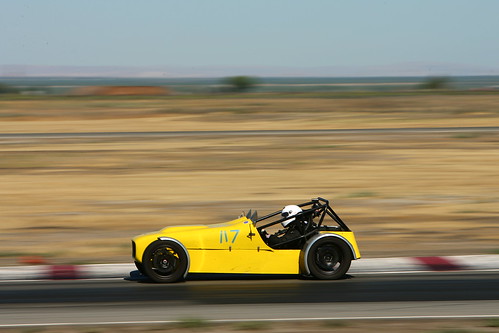
After going through many of the initial setup issues on the Seven and giving it a quick shakedown at Laguna Seca, I decided that it was time to take it on my first road trip. I drove it down to Buttonwillow Raceway Park to join a group of other Se7en owners for a track weekend. The fact that there were going to be other owners there made me feel more confident that there would be enough mechanical expertise to solve any mechanical issues that may crop up. Having been to Buttonwillow once before, I knew that the heat would be brutal and was glad to pitch in with the other folks to share a couple of garages with the other folks.

The drive down was uneventful and took me a little over 4 hours to complete. The fact that I was using my cool shirt on the drive down meant that I was extremely comfortable on the drive despite the high temperatures (80+ in Santa Clara to 98 in Buttonwillow). I even got to stop at the San Luis reservoir for a couple of great pictures.

There were 6 different Sevens taking part in the event including a Birkin, a Superstalker and 3 Caterhams (including the only R500 in the country) and we even had another Ultralite owner drop by to to say hi. The coolest car there was this maroon Caterham whose owner had put 70,000 miles on the car over 11 years but still had its looking like new. The even more amazing part was that he drove the car up from LA, completed a 2 hour enduro in it and then packed up and drove it to Lake Tahoe the next morning. :o

The track action was organized by NCRC and was up to their usual excellent standards. All of us had a blast and got to spend some quality time studying each others cars and talking to fellow Seven fans. As a bonus, Vanhap Photography got some excellent shots of the track action including a couple of staged shots of us together on track.

My favourite part of the weekend was a 4 lap sequence where I was tryng to keep up with the Caterham R500 above. The car has only slightly more power than mine (263 bhp Vs 240 bhp0 than mine but is significantly lighter (1200 lbs Vs 1400 lbs) which makes it much faster in straight line. The video below (watch it in HD) shows the action from my point of view and you can see that every time we get onto a straight he is able to pull away from me. the only reason I was able to keep up at all was because he would have to wait for point-bys from slower cars while I could just stream through the openings he made. Might be a good excuse for me to get that supercharger after all ;)

The car performed very well on track and only had a couple of minor electrical issues. I had no heat issues and the coolsuit helped keep the driver cool as well. The tires performed very well and the only real problem was the too much rear bias in the brakes. Since the Ultralite has equal size brakes front to rear and equal sized master cylinders for each as well, the rear brakes are much too powerfull and will lock up way before the fronts even with the balance bar set all the way to the front. This means that I have to brake very early to prevent locking the rears and unsettling the car. I will likely be getting wither a smaller master cylinder or a smaller rear caliper before the next track day.

After packing up early on Sunday after I headed out early hoping to make it home before dinner. I was just over the half way mark when the car suddenly started producing a loud clunk from the rear when I either accelerated or decelerated. I pulled into the nearest gas station and looked under the rear to find that one of the two bolts holding the differential in place had backed out and that the diff was actually twisting around the remaining bolt and hitting the chassis to make the clunking sound. Unfortunately replacing it will require removing the gas tank which is not the kind of job to be done by the side of the road. Luckily I was less than a hundred miles from home which meant that AAA towed me back home for free

Towed back home

All in all it was a fun trip and I’m surprised at how happy I am despite having being towed back home :) I had a great time at the track and made some great new friends. The car was fast, fun and fairly reliable on the course. I may have broken down at the end but its an obvious problem and should be easy enough to fix in time for the next event. In the mean time you guys can check out the rest of the pictures below:

  • Share/Bookmark

The physical demands of Lemons racing

Monday, October 12th, 2009

Fatigue – that’s a word you hear being thrown about a lot at endurance racing events. We know that as drivers do long stints behind the wheel, fatigue starts setting in and the lap times start to drop steadily. But the $64,000 question is how long can a driver stay out on track without compromising the performance of his/her car or the safety of the other competitors. People keep throwing around the statistic of F1 drivers having an average heart rate of 170 bpm for the 90 odd minute duration of the race. That data might be useful for a young fit F1 driver who spends the entire duration of the race on the ragged edge, but is not very relevant to the average Lemons driver who is generally older, considerably less fit, often drives longer stints and (speaking for myself) is generally well under the limit?

In order to learn more about the physical demands of Lemons racing, I decided to wear a heart rate monitor during my driving stints behind the wheel of our #23 Pink Pig E30 at the 24 Hours of Lemons race at Buttonwillow this past August. Our friends at Chasecam lent us a PDR100 video kit and copy of their Dashware software that allowed me to sync my heartrate to both the video stream and the in-car telemetry collected using my Race Technologies DL1 data logger. The following is a summary of what I learned with some things being as expected and some things decidedly unexpected.

Current Fitness Level
I’ll start by giving a quick baseline values for my current fitness levels. I have a resting heart rate of just under 50 bpm and I run between 10-20 miles a week which puts me in the above average range of physical fitness. Click here to see an example heart rate trace from my last long run (outdoors, 85 F, 8.5 miles in 84 min, avg heart rate of 164 bpm).

Additionally since Buttonwillow in August is brutally hot (temps of 110 F are quite common) I did hot weather training (outdoor 10k twice a week at 2 in the afternoon) for a couple of months to help prepare for the heat stress. The temperatures during the race ended up being about 100F and I did wear a Cool Shirt which I used intermittently for the first hour and then continuously after that.

Data summary
stint 1 raw
The graph above shows my heart rate during a 2 hour 50 minute recording window. My average heart rate during this entire period was 120 beats/minute with a maximum of 165 bpm. As you can see there are several distinct segments where my heart rate varied significantly from the average. By syncing the heart rate data to the video I was able to find that each segment points to a specific event during the race.

Specific instances
stint 1 start
Looking at the first 25 minutes of the data you can see that my heart rate initially hovers around the 90 bpm mark. At this time I was lined up in the pitlane and waiting for the cars to slowly get released onto the track. The small spike at the 4 minute mark happens exactly as I get out of the pits and onto the racing service. I should add that I had never driven a single lap of Buttonwillow before (mechanical issues on Friday) and was very nervous about going blind onto a new track. As I start doing the yellow flag laps you can see that my heart rate starts dropping again and stays that way for the next 7-8 minutes as I slowly learn my way around the track. The next spike you see is at the 12 minute mark and is shown in this short video below which has my heart rate in the top left corner.


As luck would have it the car right behind me was given the green flag which meant that I had zero warning of the race start. As the cars behind start passing me on the straight my heart rate starts rising from the low 90s and hits 129 bpm in the middle of turn 2.

stint 1 2nd half
The graph above shows the last 90 minutes of my stint. There is a gradual drop-off in my heart rate starting at about the 1:21 mark. This corresponds to a long full course yellow out on the track. The heart rate initially does not drop by much as I am staying close to car in front so that I can pass it at the next green flag, but as I drive further along the course I realize its a full course yellow and start relaxing which drop my heart rate to just over a 100. You can see another example of it in the video below which shows a yellow flag segment from my second stint on day 1.

The second dip you see towards the end of my day 1 stint happens when our car breaks down on the exit of turn 1 and I pull off the course and stop. While I’m initially quite agitated as I try to restart the car, I quickly realize that the car is dead and my heart rate starts dropping to the 100 bpm mark. About 5 minutes later the tow truck pulls up to the car and tows me back to the pits. Once I get there my heart rate once again starts rising and goes well past the 150 mark as I get out of the car to try and help fix the problem. It goes back down to the 140 mark as the problem is found and fixed but then rises to a peak of 165 as I am refueling the car (a 40 pound fuel can on your shoulder will do that).

As I went through the data, the most surprising fact for me was that the heart rate does not seem to have much correlation to the speed, g-force, laptime, etc… In fact it seems more psychological than it is physical. While there are some small changes over a lap, there are no significant bumps going through particular turns or even when passing individual cars. Instead the most pronounced changes in heart rate happen when you come up on a large group of cars and are unsure of how to pass them. The following video is a great example of this. Initially my heart rate is in the 115-120 bpm range as I go through the sweeper by myself. As I catch up to a group of five cars it rapidly rises and peaks at 144 bpm as I pass the last car. As soon as I pass them it starts dropping quickly and levels back down at the 120-125 bpm range.

For comparison here is a clean air lap where it drops as low as 97 bpm with a temporary spike at 131 bpm but spends the majority of the lap between 115 and 125 bpm

Summary
My stint in this case was for 2.5 hours in 100 degree weather and I could probably have driven for another hour. One thing to note is that I have plenty of experience driving on track (karting enduro, HPDE, Lemons) and can tell when my performance level goes down. If you are not familiar with driving on track and/or are driving at 10/10ths you will get mentally drained well before you get physically fatigued. If you dont take car to monitor your concentration you will start making more and more mistakes. The optimal stint length can and will vary dramatically even for the same person depending on their mental and physical state – I did a 4+ hour stint at Lemons Thunderhill 07 with no problems but when I drove a Spec Miata there I was wiped out in just 45 minutes.

In summary I can say that while Lemons is indeed quite strenuous, the mental aspect is more taxing than the physical. If you are used to good cardio workouts and can monitor your own concentration levels, it is possible to safely to do long stints. All this of course only applies to me and the way I drive – your mileage WILL vary and I make no statements about your driving abilities

Bonus video
And finally as bonus here is a 15 minute battle I had with the Itallion stallions Fiat X1/9. It starts off with them passing me on the run up to the hill and I then spend the next 15 minutes trying to get the position back. I’ve speeded up the sections where I am trying to catch up to them while the close quarters action is at regular speeds. Total run time is a little over 10 minutes. My favourite section is at the 6:20 mark where I pull alongside on the exit of the bus stop and we go side-by-side for 3 corners till I finally have to give up because they have the inside line over the hill. In case you are wondering they have modified the X1/9 to run motorcycle carbs which is why they were able to stay ahead on the straight. Plus this is within the first 10-12 laps on track so I’m still not very familiar with the track which I hope excuses the bad driving :-)

  • Share/Bookmark