Archive for the ‘personal’ Category

Emergency Preparedness Pack

Wednesday, April 6th, 2011

One of the big things that the Japan Earthquake brought home to me was my absolute unpreparedness for any sort of disaster or emergency evacuation situation. I spent a bunch of time online looking for pre-made emergency “bug-out” kits and while there are several decent ones out there I felt that they were all missing various things and decided in the end to make my own. I figure I will share the contents of my kit for other folks who might be interested in making one of if they have comments on things I should or shouldn’t have. Many items will have two links because I have explicitly bought two different brands in order to increase redundancy and reduce the impact of a bad product batch.

  1. Cash: One thing that ALL emergency packs fail to include is cash. While the exact amount is up to the individual, I’d recommend keeping both large and small denomination bills. Quarters might be something worth having at well though I haven’t put any in myself.
  2. Keys: House and all cars
  3. Papers/Documents: As a non-citizen I am very aware of the need for papers an am keeping a copy of our passports and various other immigration papers in a waterproof pouch. I also keep a Sharpie-written copy of important phone numbers with my documents
  4. Waterproof thumbdrive: We store a digital copy of all important papers (identity, accounts, property) on waterproof thumbdrives as well
  5. Food rations: Mainstay emergency food rations with low sodium content and a 5 year shelf life
  6. Water purification: Micropur tablets are supposedly the best tasting and most effective ones out there but takes 4 hours to take full effect. Iodine crystals are not as tasty but only need an hour and have an indefinite shelf life (if unopened)
  7. Water: This was one of the harder discisions to make. I considered going with the prepackaged water pouches but the cost and shelf life issues made me decide to go with simple one gallon supermarket jugs along with a couple of water pouches in each pack
  8. Medkit: should include the following – bandages, asprin, NSAID, bandaids, burn gel, antiseptic, haemostat (Quikclot), sunscreen, compression bandage, scissors or trauma shears, gloves, flexible splint, safety pins. I picked up one of these which includes a decent selection of stuff in a nice case with enough space to add the extras. I also have one of these harder core kits
  9. Knives/multitool: Knives and multitools are another thing that most commercial kits seem to miss out on. I picked up the CKRT Guppie(knife/carabiner/screwdriver/light), Tool Logic SLP2 (knife/flashlight/firestarter) and Gerber multitool (leatherman style)
  10. Glowsticks: 12 hour glowsticks from two different brands. I have 5 in each pack plus a few more in each car. I tested one of these and it worked great for 12 hours as promised
  11. Flashlight: LED type
  12. Fire source: Waterproof matches and a Firestarter (this particular firestarter sparks well but after 15 min I still hadnt gotten a fire going)
  13. Mylar blankets: Another thing that I put into my cars as well.
  14. Particulate Masks
  15. Duct tape: As all engineers know – “duct tape can fix everything”
  16. Gloves: Nitrile and work gloves
  17. Caps and Beanies
  18. Trash bags: Come in handy for storing stuff in a pinch
  19. Clothing/shoes: Warm and waterproof clothing with everything sized for the largest person in the house so that everyone can use any pack.
  20. Feminine hygiene products: Something us guys dont usually think about :-)
  21. 12V to USB adapter: Plus USB charging cables for all your cellphones
  22. Carabiners: These are primarily to allow me to add other things to the bag if I ever need to
  23. NOAA Radio
  24. Adjustable wrench: This isn’t actually in the kits but is in the garage to quickly turn the gas shut-off valve if needed
  25. Doggy stuff: Poop bag rolls, spare harnesses and leashes, foldable water/food bowl

I am creating two packs with the larger pack stored upstairs near the bedroom and the smaller one in the garage. Each pack having pretty much the same things with the exception that the larger one has extra clothing and also has a pair of shoes each laced to the straps. The idea being that the upstairs pack will have to suffice if you have to run out from bed. The smaller pack has less clothing under the assumption that if you are downstairs you already have on some shoes and clothes – this also makes the pack lighter which is a good option to have. Additionally the upstairs pack is stored on its own shelf which makes it easy to find in the dark while the garage one has some bright tape on it for easy identification and has its own spot on the floor near the door.

I hope folks find this list useful and I would love to hear feedback about things I should or shouldn’t have.

Lotus Management on the Future of Lotus (GGLC Exclusive Interviews)

Monday, November 29th, 2010

Cross-posting the interviews I conducted for the GGLC at the LA Auto Show and originally posted on the GGLC blog:

GGLC attended the North America launch of the new Lotus range at the LA Auto Show and got a chance to speak to senior management about their plans for Lotus and the challenges in launching 5 new cars in a short span of time. Short descriptions of the interviews and their major points are below but we recommend you watch the actual videos to get a sense about the future direction of Lotus

First up we spoke to Dany Bahar, the CEO of Group Lotus about his vision for the future of the company and why they were launching so many cars in such a short timeframe. Major points that he confirmed were:

  • Not all cars will be going to aluminium skins, the Elise will remain a composite body
  • Motorsports activities will include Evora GT4, Evora GT2, IndyCar (bespoke engine and aero)
  • Simultaneous worldwide launch with an intended volume of 6-7000 cars per year

Next up was Donato Coco, Head of Lotus Design and the man behind the 5 cars on display. He spoke to us about the challenges in designing iconic cars like the Esprit as well as the goals for the design language for the Lotus range. Our favorite quite here was that the design for the new front ends has been inspired by the original Lotus Seven and if you look at the cars (especially the Elise) it does actually come through.

Finally we spoke to Wolf Zimmermann, CTO of Lotus about the challenges in rapidly developing 5 new cars. This was a great interview with reasons behind various decisions and we recommend you watch the whole video below. Significant points include:

  • Aluminium bodies are required because composite cannot provide the required quality and shapes for the new designs
  • Engines are not yet confirmed but will be decided in the next few months
  • VVA architecture and manufacturing will have to be upgraded to meet targets
  • Lotus Engineering is already involved in some of the design processes

FamousFood.us: Find the restaurants featured on your favourite TV shows

Tuesday, October 26th, 2010

As some of you may already know, I have recently launched a new website named FamousFood.us that allows you to quickly find restaurants featured on TV shows such as Best Thing I Ever Ate, Diners Drive-Ins and Dives, Throwdown with Bobby Flay, etc.. as well as Michellin guide rated restaurants. I figure it finally time for me to write a blog post explaining the site and what I hope to do with it.

The idea for the site came from my summer road trip to Seattle. Since Nithya and I were driving up there with no specific plans we decided that we wanted to try out as many of the Best Thing I Ever Ate restaurants as we could using my existing map as a guide. Right off the bat the first problem I found was that 3 of the restaurants were literally on the same street corner which meant that you didn’t actually see them on a map until you zoomed in all the way. Secondly when you are a stranger in city you don’t really know where you are which makes it quite difficult to look up a map. And last and perhaps most importantly, the map based method was really difficult to use on a mobile phone. Web based mobile maps just are not pleasant to use on the phone.

All these issues led me to think about my requirements for a site to find TV featured restaurants
1) Must work on both PC and mobile. Should play nicely with a variety of different screen sizes.
2) Must autodetect location though users should also be able to set a different location
3) While maps are nice, lists are more important especially in mobile
4) Must be able to pick and choose from different shows
5) Show as much information about the restaurant, show and episode as possible without requiring another page load
6) Get Yelp ratings if possible

On the technical side, I had recently made some simple Nokia WRT widgets (HTML/CSS/Javascript) and I decided to use a similar setup to create a single page javascript web app rather than a complex multipage site. While this would increase the initial load time, I felt that the responsiveness of the app when loaded would be a definite plus especially on the mobile. As an added plus I had always wanted to build an end-to-end web app and this was the perfect opportunity. I would be building everything from the database and API to complete front end including all the (admittedly ugly :-) ) graphics. I also got to play with some HTML5 geolocation, CSS and Javascript which was quite an instructive experience.

The first thing I did was to create a single database that included all the restaurant information that I had collected for my existing mashups of DDD, Best Thing and Throwdown. In addition I decided to add restaurants from the 2009 and 2010 US Michelin Guide. Now the Michelin guide may seem out of place in a list of TV restaurants but as the designer it was my perogative to add the things that I wanted to see ;-) . The next step was to create a simple JSON API that would allow me access a distance sorted list of restaurants as well as the ability to filter based on specific shows.

FamousFood.us
Once the API was done, I moved on to creating the front end. It begins with a splash screen above that displays a spinner while it attempts to get the users location. Once the coordinates are obtained they are passed through the Google Maps geocoder to get a human readable location name. In the meantime the front end displays a list based UI which allows the user to select either “All shows” or specific show. This UI is not the most elegant on the PC but it works well on the mobile and allows me to provide reasonable functionality for both with a single design.

FamousFood.us

Once a show has been selected the web app fires off a request to the JSON api to get the nearest restaurants that fit the required criteria. The returned data is displayed as lost with the name of the restaurant, name of the episode, distance from the user and a colour coded Icon for the TV show. The users also have the option to click the “Map” button the top of the page to see the same information on a map with colour coded pins.

FamousFood.us FamousFood.us

Once the user selects the restaurant they are shown all the info about the restaurant such as address, phone number, website, etc… as well as show and episode information. All the information is hotlinked so that the user can directly call the restaurant, get driving directions, visit the episode home page etc… with just a click. The page also fires off a request via the Yelp API and displays the current ratings and reviews for that restaurant.

FamousFood.us

And as a final mobile tweak I have setup the site such that iPhone user can directly add it as a web application to their home screen. Just tap the “+” icon in browser and select “Add to Home Screen” in the next menu. This will add a FamousFood icon to your homescreen and allow you to launch the app without having to explicitly open a web browser or select a bookmark.

And that is basically how I built FamousFood.us over a roughly 2 week period. Nithya and I used it extensively during our trip to New York earlier this month and ate at some fantastic restaurants (more in another post). Since the trip I have been adding more shows to the database and the current lineup includes Best Thing I Ever Ate, Diners Drive-Ins & Dives, Food Wars, Man V Food, Throwdown with Bobby Flay and the Michelin Guide. I have linked to site from my 3 existing mashups and am currently getting averaging about 85 hits per day. Head on over to FamousFood.us and try it out for yourself. If you like the site please spread the word (and the link love ;-) )

Picked up some Lotus History

Saturday, May 22nd, 2010

Piston from Lotus Cosworth DFV 339

The mailman just brought me this amazing piece of Lotus F1 history: a piston from the Cosworth DFV engine #339 used in the Lotus 81 Formula 1 car.

Piston from Lotus Cosworth DFV 339

In the 70s and 80s, Team Lotus was in the habit of keeping the pistons from rebuilds to use as VIP gifts. Each engines pistons were labeled and stored but not all were presented. With reference to the teams archives, Classic Team Lotus is able to identify the detailed competition history for the engines in which the pistons ran. A great deal of polishing, then mounting on a wooden plinth, complete with presentation plaque, makes a rather special item of memorabilia.

Piston from Lotus Cosworth DFV 339

Now while a piston from an F1 engine is amazing in itself (Ferrari charges >$600 for a 2000 piston), this particular engine has some additional history that makes it even more unique. The DFV 339 was used by not one but two F1 world Champions: Mario Andretti used it in his final season at Lotus while Nigel Mansell used it during his first two seasons in F1.

Piston from Lotus Cosworth DFV 339

The piston comes with documentation of the engines usage and you can see that while it was used primarily in practice and testing, it was also used by Andretti in the 1980 USA GP West where he retired after a first corner accident.

DFV 339 History

If you’d like to get your hands on some original Team Lotus history, head on over to the Classic Team Lotus webstore and be prepared to fight the temptation to buy out the entire store.

Setting up a Seven – The Ultralite Experience

Tuesday, March 30th, 2010

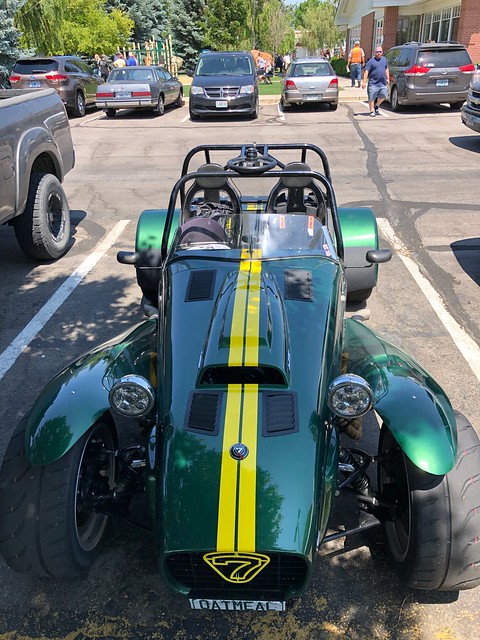
My new WCM Ultralite S2K

As many of you know I purchased a Lotus Seven replica called the WCM Ultralite S2K late last year to make it a street legal track toy. While the Ultralite may maintain the spirit of the original Seven, as you can see below, it has a distinctly different shape and has generally larger dimensions to accommodate drivers of all sizes. In order to move this extra bulk (relatively speaking) around it comes with the incredible F20C engine out of the Honda S2000. The end product has some astonishing performance figures:

Weight: 1300 lbs
Horsepower: 240 bhp
Redline: 9000 rpm
Power to weight ratio: 400+ hp/ton
0-60 mph: 3.5 seconds

With the (more) original predecessor

My particular car was the first prototype built by World Class Motorsports and is the actual car used in most of the magazine tests. The original owner of the car then sold it to an active PCA member who took fantastic care of the car and documented his changes. He also had the car made street legal under the California SB100 exemption for kit cars. After a few years he ended up selling it and the car went through 2 other owners before I found out that it was on sale again and jumped at the chance.

The previous owner of the Ultralite going through the corkscrew

The first and most immediate thing that hits you when driving the Ultralite is sheer mind-blowing acceleration. When I bought the car it was on a set of fairly old 235 width Falken Azenis. Now while the Azenins are actually pretty good tires for autocross, they have nowhere near enough grip for the ridiculous horsepower of the Ultralite. The very first time I tried a hard acceleration run I spun the rear wheels in 3rd gear and got a full on fishtail moment at 60+ mph. This is the only car I have driven where you have to rev match on upshifts or the rear wheels will happily lose traction :D Even within the same gear the acceleration is phenomenal. The car pulls pretty strongly below 6k rpm but once you go above the 6k threshold the VTEC cuts in an it feels like someone has hit the fast forward button. Plus with the 9k redline you have plenty of time in the powerband and dont have to keep rowing the gears. Also despite the fearsome power, I do have to say that the Ultralite is actually a very benign handling car. The rear gives you plenty of notice before it steps out and you can easily use the throttle to play with oversteer through the bends (see opposite lock below :) ).

Driving the Seven is very visceral experience where you can see, feel and hear every mechanical thing on the car. While you are “one with the road” it is a very different experience than what you feel in a Lotus Elise. The Elise is delicate, nimble car and will eagerly follow your every command while the Ultralite is like a raging bull that you have to manhandle into position before you step on the throttle and hold on for dear life. It is very much of a “mans car” where the controls are very heavy and you end up smelling of oil and gasoline after every drive. :)

Offroad Seven

While the car was in running, registered and mostly-drivable condition when I bought it, I nonetheless had several improvements in mind before it would be truly track worthy. While this car is likely to be a project car for the rest of my life, for the more immediate future I plan on a series of “Setting up a Seven” blog posts about work I have already done including the safety setup, wheels/tires, exhaust, suspension, etc… In the meantime enjoy this video of Rob doing a run at the last Lotus Club autocross of the 2009 season.


video by cxcheng