Archive for February, 2007

Recording in-car video for free

Tuesday, February 27th, 2007

I am a great fan of in-car video during HPDEs. It is a great tool to analyze your performance and see how different lines have affected you laptimes – works even better when you have a DL1 or some other data logger. In-car video is also a great way to give people an idea of what its like to track a car and maybe even understand you keep grinning from ear to ear after each event.

However when I see the average setup (for an Elise) at an HPDE it looks to go one of two ways

1) The full on treatment: This is a full on video system that gives you the best quality video and audio and will usually record several hours without any issues. Some of the equipment that this requires is

This kind of a setup will give you close to pro level AV and is the next best thing to actually sitting in the car. However the total price tag of around $1200 bucks (not including harness installation) is usually out of the price range of all but the most avid track junkies.
2) Track video lite: This setup tries to replicate the quality of the track video but uses consumer grade electronics and usually does not leave any permanent alterations to the car. The parts list includes

  • Suction cup mount: $40-100 at Chasecam
  • Solid state Camera: $300-$500 for either commercial point and shoot camera or a consumer camcorder
  • Solid state memory: ~$100 for a 4 GB CF card
  • Portable storage: Since these cameras fill up memory very quickly you will have to download the video between sessions to either a laptop or a storage solution like the Wolverine ($150)

This system is considerably cheaper (~$550 excluding storage) and is probably the most popular HPDE setup. The quality is pretty decent (800 x 600 or 640 x 480) though people say that the vibration affects the image stabilization systems on these cameras and track life is only about 2 years. Additionally you have to use some sort of storage system to suck the video out between lap sessions and that can get tiresome. While you can mix and match components to get a setup for < $500, it's still quite pricey for someone who is still deciding how much to invest in track equipment.

A looking for a cheaper alternative
This got me thinking about possible ways to record video for free to see how useful it is before actually investing in a full on setup. One of the most ubiquitous technologies to emerge in recent years has been the cameraphone which invariably has a video mode as well. Now off course the video quality of the cameraphone is dependant on the device, but newer devices usually have at least 2 megapixels and can use large memory cards to store virtually limitless video. Phones are built to withstand rougher use than a camera (they go through several types of drop tests) and being solid state they are less affected by vibration. I then decided to build my own in-car video setup using a cellphone.

My Setup
The latest device that I have been playing with is the Nokia N73 which has a 3.2 megapixel camera and can hold 2GB miniSD card. It records video at a resolution of 320 x 240 and saves it as mp4 files which can be read on any PC. Since an hour of video only takes ~300 MB, I knew that a 2GB would be more than enough to record video for an entire track weekend. I didnt mind spending the money (~$40) on the card because I knew that even if I didn’t use it for video I would definitely use it to store music on my phone.

The mounting device was little trickier, the cameraphone has no mount points on it which meant that I couldn’t use any of the traditional mounting systems (would have been out of my budget anyway). However while looking at the interior of the car I realized that the back window of the Elise is perfectly vertical and if I could attach the phone to the window I would probably be able to get a good view out the front.

When it came to the actual attachment I decided to use painters tape instead since it has relatively high shear strength and leaves no residue which is important since I didn’t want to mess up my phone. Additionally the N73 only weighs a 116 grams which will barely put any shear forces on the tape. This mounting system will of course only work for candybar style phones and not clamshells because you cannot tape an open clamshell to the inside of the window. You begin by taking a 2-3 foot strip of painters tape and cut a small hole in the center for the lens.

You then open the lens cap of the phone if any and place it on the tape such that the lens is right over the hole. If your phone does not have a side accessible button to turn on the camera you will have to turn on the camera and start recording at this point.

Now you just take the strip (with the phone attached) and tape it to the bottom edge of the rear window. You can add some padding material between the glass and the phone though I found that this really wasn’t necessary.

Thats it – just remember to turn on the phone camera at the start of every session.

The video shot this way is obviously not as good as the video from the earlier systems but for its price ($40 for the card and $1 for the tape) it gives more than enough detail to understand what is happening at the track. Additionally if you are going to post the video online on YouTube, Google Video or Yahoo video, these system usually transcode your video down to 320 x 240 anyway so you arent really loosing that much quality. I am looking forward to getting my hands on the new Nokia N95 which shoots video at 640 x 480 – that should really give the other systems a run for their money :-)

You can download a full resolution video from here (9 MB transcoded WMV). I have also made a JumpCut video of my best lap (and a small ‘incident’) with captions and other fun stuff – RSS readers point your browsers here.

UPDATE: I have posted some sample track video from the N95 in a separate post – the video quality is dramatically better and good enough to postpone my PDR100 plans

  • Share/Bookmark

The Tesla Roadster – the perfect Elise?

Tuesday, February 20th, 2007

I had the opportunity to visit Tesla Motors on a tour organized by SFF1 and would like to write up some of my thoughts about the company, its technology and their first car. This is going to be from the point of view of a petrol head engineer who daily drives an Elise – take it how you will :-) .

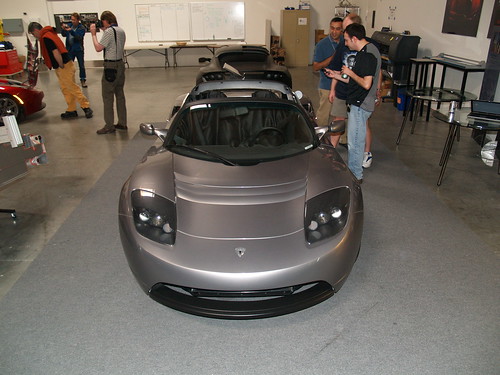
In case you haven’t heard of Tesla, on account of the rock you have been living under for the last 6 months, it is a Bay Area automotive startup that is designing and building the Tesla Roadster which will be the worlds first mass produced electric sports car. I have been especially interested in the Tesla since it based on the Lotus Elise chassis and is in fact assembled by Lotus in Hethel in an arrangement similar to that used on the Opel Speedster/Vauxhall VX200. However unlike the Opel/Vauxhall, which were more like badge engineered Elises, the Tesla uses a substantially modified Elise chassis with an all-electric powertrain and is a whole new beast. I had already had my first look at the car during the Palo Alto British car meet but this tour was a chance to actually look at the car internals and to talk to some of the people behind this revolutionary machine.

The most important piece of new technology in the car is of course its electric powertrain. Unlike established car companies which are have a “not invented here” complex and prefer to develop their cars from scratch, Tesla followed a startup mentality and tried to source as much of the technology as they could. The most obvious example of this is in the way they created the battery pack for the car. Instead of trying to come up with new battery technology, they instead sourced the fastest growing battery technology available today – the Lithium Ion batteries used in notebook computers. They use 6831 off-the shelf Li-Ion cells to form a 50 kW battery pack that provide the power for everything on the car. For those of you who are worried about exploding batteries – Tesla uses a lot more battery management technology including a heating/cooling system that keeps the batteries at their optimum operating temperature irrespective of the outside temperature.

Lithium - Ion batteryTesla Battery pack

The electric motor spins up to 13,500 rpm and produces 248 bhp and 200 ft/lbs of torque while weighing just 125 lbs. The most startling thing about the torque is that you have maximum torque starting from 0 rpm all the way to 6000 rpm where it starts to slowly reduce. The entire powertrain has only 17 moving parts of which 15 are in the gearbox which is a clutchless 2 speed setup where 1st will take you to almost 70 while 2nd tops out at 130 mph. There is no reverse gear – the motor (which has just 1 moving part, the rotor) just spins backwards when you want to reverse.

Following the technology sourcing mindset further, Tesla sourced the entire chassis from Lotus. By doing this they not only got one of the best handling chassis in the world but they also gained instant credibility by partnering with a 7 time F1 world champion constructor. The bonded aluminium chassis is a modified version of the Elise chassis and the front half looks to be identical to that of the Elise. The side sills have been lowered 50 mm to enable (relatively) easy ingress/egress which should make the Tesla more livable than the Elise. The rear subframe has been modified to hold the battery pack (900 lbs) and the motor (125 lbs) in the same position as the Elise engine to get similar handling characteristics. Following the Chapman philosophy of “simplify and add lightness”, Tesla has gone to great lengths to lower the weight and uses an all carbon fiber body to keep the weight down to 2500 lbs. The front suspension is identical to the base Elise except for the use of the AP Racing ‘big brake’ kit to handle the added weight of the Tesla.

Tesla Roadster chassis

The performance figures on the Tesla Roadster are pretty amazing:

  • 248 bhp
  • 0-60 in 4 seconds
  • Top speed of 130 mph
  • 250 mile range
  • CO2 emissions equivalent to 135 mpg
  • Zero maintenance (The lack of moving parts means that the only mainteneace needed is a brake fluid change every 3 years)

Tesla as an Elise replacement

As you can see from the pictures, the Tesla looks very similar to the Elise and makes many of the same compromises. The end result is however quite different and while not as focussed as the Elise it can actually be a better alternative for many owners. I see the following pros and cons while comparing the Tesla with the Elise:

Pros

1) General livability: The Tesla beats the Elise hands down when it comes to general livability. Ingress/egress is a lot easier and the car comes with a lot more features like satnav and heated seats. The quietness of the electric motor will make it a lot less tiring to drive.

2) Performance: The massive torque of the Tesla means that you no longer have to wait for the second cam before being able to pass someone. Its handling will probably be not as pure as the Elise but I am confident that Tesla and Lotus will bring out a great handling car.

3) Urethane bumpers: The Tesla has urethane bumpers which should keep the car safer from braille parkers – the Elise owners cracked clamshell nightmare should become a thing of the past.

4) Even more exclusive than the Elise: The Tesla will be even more exclusive than the Elise – while I don’t care about this particular point I will admit that there are people out there who prefer exclusive cars

5) Sticking it to Prius owners: You can tell the “holier than thou” Prius owners to go screw themselves because their car is slow gas guzzling piece of crap. The Tesla is a near supercar that appeals to both car enthusiasts and environmentalists.

Cons

1) Price: ~$90k is a lot of money especially when you can get a Noble for the same money. The initial buyers will be buying the Tesla for electric car bragging rights just as much as its ability as a sports car.

2) Need a second car: The low range of the Tesla means that it can never be your only car – you can daily drive it but you need to have a backup car in case you need to make the round trip. This shouldn’t be too much of a problem since the average Elise owner only puts a few thousand miles a year on his/her car – my 20+k a year are an exception

3) Top speed of 130: The top speed of the Tesla is only a 130 miles an hour which prevents it from entering true performance car territory, but honestly how many people very actually get their car past 130 on the public roads? The better torque and passing ability of the Tesla should make it the more practical car on the street.

4) Looks: Informally talking to the people at the tour most people felt that the Elise looked a lot more exotic than the Elise. I think this was only an issue because the two cars were next to each other, the average lay person will still confuse the Tesla with a Ferrari.

5) No track days for you: The range of the Tesla really prevents you from tracking your car (unless you have your own private track in your back yard). One of the greatest selling points of the Elise/Exige is the ability to drive the car to a track, flog it for a few hours and then drive it back with now problems whatsoever. Since the my nearest track is over a 100 miles away this makes it a real deal breaker for me – there is no way I can justify spending $90k on a performance car that I can never track.

In conclusion I can say that the Tesla is more accessible to the general public and they will be selling them as fast as they can make them. It may not meet my needs in car but I will definitely recommend it to people who are looking for a fun second car with no track aspirations. It is an amazing car and real technological triumph – an electric car that can thrill you with absolute performance while still making you feel good about saving baby seals.

For more pictures from the Tesla tour (including more pics with my Elise) visit my Flickr photo set.

Cross posted on EliseTalk

  • Share/Bookmark