Archive for July, 2007

What is Mobile Spatial Interaction?

Sunday, July 15th, 2007

Helping organize the Mobile Spatial Interaction (MSI) workshop at CHI 2007 has made me very sensitive to the usage of the term MSI. Most people see Mobile and Spatial attached to Interaction and immediately start talking about location aware applications and services. However as someone who has spent the last few years working on location-aware applications, I have always felt that MSI and location-aware apps are two slightly different classes of research. As a result I’ve been spending some time thinking about how to define MSI as well as understanding how it differs (if it differs at all) from the current of location aware applications. My definition of location aware will of course be highly biased by projects like FireEagle, ZoneTag and Zurfer)

Location
I define location aware systems as systems that know the users absolute position. The accuracy of the location will of course change as will the source input (IP, Cell tower, GPS, user sumitted), used but by definition all location-aware systems can locate the user down to some arbitrary level of accuracy. The available accuracy may vary widely from country to city to zipcode to lat/long, and typically the best possible accuracy comes from GPS receiver which has an average error rate of about 30 feet.

MSI on the other hand requires not only the users physical location but also their spatial orientation (heading at a minimum but possibly including information like tilt, height, etc…). Typically MSI also requires a greater level of location accuracy – most spatially aware systems cannot do much with city level location and generally require at least GPS level location accuracy. In many ways you can consider the MSI grade location (and orientation) to be the logical conclusion of ever improving location aware technologies.

Interaction
To me the greatest difference between location aware and MSI applications is in terms of the interactions that they can enable. A location aware application has more of a “smart” interaction where the app tailors the content based on your location. ZoneTag is an excellent example of a location aware app that suggests tags based on your current location. To the user it appears to be a smart application that just knows what the user probably wants.

MSI interaction on the other hand can go much deeper than just smart apps. Sure it would be awesome to have a version of ZoneTag that showed the tags for the object you just took a picture of but that’s the obvious and (relatively) easy part. To me the real killer app for MSI is in enabling the creation of tangible* intuitive user interfaces. Interfaces that actually interact with their physical surroundings will not only have greater adoption (due to easy learnability) but peoples innate curiosity and playfulness will make the interaction more pleasurable (if you’ve ever seen a group of tenured professors act like children at a SmartSkin table you know what I mean :) ).

Magic
Ubicomp researchers have been trying to make these intuitive interfaces for years but have been hampered by the artificial nature of the sensing technology. With mobile phones becoming more powerful and increasingly including things like GPS, digital compasses, accelerometers, tilt sensors, etc… it isn’t going to be too long before every person is walking around with an MSI/Ubicomp enabling device in their pocket. If MSI researchers have their way people will no longer have to squint at tiny screens, explicit interfaces will disappear and users will directly query and interact with their real world environment. We still have a long way to go before we get there but projects like Air Messages, Point and Find, relateGateways, etc… are beginning to show how users can interact with the real world. They are opening a while new set of research questions about how people will react to such technology – I don’t know what the killer app will be but I’m pretty sure the interaction will be indistinguishable from magic.

* I am using the word tangible since even gestural MSI is situated in the physical environment.

[tags]MSI, Mobile spatial interaction, location-aware, lbs, research[/tags]

24 Hours of Lemons

Sunday, July 8th, 2007


I’ve been very interested in the 24 Hours of Lemons since I first heard about it last year and when I found out that the first race of the year was this past weekend I just had to go check it out. The Altamont Motorsports Park in Tracy, CA is the home of the race and features two ovals which are interconnected to create a road-course for the Lemons race. The cars all had to be bought and race prepped for under $500 (excluding safety gear) with a team of 4-6 drivers. Despite the name the actual racing would only go on for about 14 hours with a 10 hour break at night to let people recuperate as well as repair their cars.

Wheel of Misfortune
I got there just as the drivers meeting got underway and found that it was pretty well organized. The organizers were very strict about a no bumping/no blocking rule and had come up with a set of humourous punishments for the drivers that broke the rules. The competitors would spin the “Wheel of Misfortune” and have to serve whatever penalty that came up. Some of the penalties included:

  • The Al Gore Carbon Replacement penalty: The competitor would have to wear a tie-die shirt and then plant a rather large sapling in the ground before they could continue.
  • The Colonel Sanders where the participant would be doused in soapy water and then feathered using large pillows.
  • The Legion of Odour involved hanging a half pound of smelly blue cheese around the drivers neck as well as placing another pound of it on the hot intake manifold – should make for a truly odourous experience.
  • The Egg Man winner (or loser) would have an open bucket of eggs welded to the hood of their cars – the idea being that as they drove the eggs would fall out of the bucket and smear the car.
  • My favourite was the Highway 17 penalty where the driver would have to follow a VW microbus around the track for 10 laps.
  • Anyone who bumped other cars on the track would initially have a set of training wheels welded to the sides of their cars
  • Repeat “bumpers” would get the Sword of Damocles penalty where a plate with sharpened spikes would be welded to their radiator with the spikes pointing inwards. At this point they were let out on track knowing that their next bump would be their last.

The organizers required that the drivers have some sort of competition license and the racetrack was more than happy to sell you a NASCAR license at the gate for just $75 dollars. The fact that people could buy licenses at the door was the main factor that dissuaded me from running the Lemons race last year – after all who want to be side by side with a novice driver in a $500 car. However it looked like the penalties did a good job of keeping the track action pretty clean – the serious racer didn’t want to lose the time while the joyriders didn’t want the embarrassment. The speeds are low as well which keeps the event pretty safe. One of the teams was racing an 80′s Golf which went into the tirewall and flipped onto its roof. The track was immediately red flagged and the safety vehicles were at the car in under 5 minutes. The driver was completely unhurt and with the help of the marshal he roled the car back onto its wheels before continuing with the race :-) .

All in all it was a great event and I am seriously trying to get an official SFF1 entry together for the October race (UPDATE: We just got accepted into the October event) – wish me luck. In the meantime you can look at a video I shot as well as some photos of my favourite cars. I have posted the full collection of photos on Flickr though you will probably be better off looking at the excellent photoset that Nithya just posted.

Video of the first few laps of the race:

Shagpile is an excellent aero-aid:

Got Jesus?

The Ford Cow:

Do or Die:

A Japanese Zero:

Squadra Pinto:

Photo in SCCA SportsCar magazine

Tuesday, July 3rd, 2007

My first magazine photo

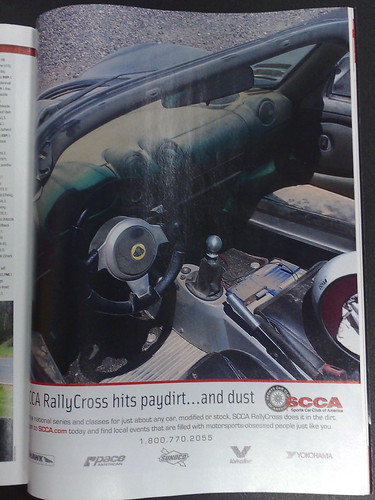
One of the photos I took of my dust covered Elise has been used in an SCCA RallyCross ad in the July Issue of SportsCar magazine. And no I do not RallyCross my Elise – the dirt was a result of my Reno-Fernley spin. It was taken with a Nokia N95 and looks remarkably good in a full page print advert (proof image here).

This happened a few weeks ago but I only just got around to blogging it :-)

[tags]scca, ad, lotus, elise, dirt, rallycross, advertisement, sportscar, magazine, nokia, n95[/tags]