Archive for the ‘24 Hours of Lemons’ Category

Test day

Saturday, October 20th, 2007

Yesterday we had a pretty good test day at Altamont. All of us did a few laps behind the wheel to get a feel for the car and the track. The car ran very fast and we all did 54 sec laps with Jyri doing a best of 52. We did have some tire wear issues with our right front tire due to the long banked turns – we will be doing some emergency camber adjustments to the front to fix that.

Here is a photo of me passing someone on the outside of the banking and a video of Jyri doing some quick laps under lights.


Hot laps from rnair on Vimeo.

  • Share/Bookmark

Seat Time

Friday, October 19th, 2007

One of the most expensive parts of the Lemons car is the seat – a good fiberglass seat will run you at least $500 dollars and even an aluminium seat will cost > $300. Now if you are preping a regular race car thats not a problem, the seat will usually last the lifetime of the car. In our case the car will most probably last only 1 race and it did not make too much sense to spend more than the cost of the car on just one seat. Enter Terry Griffin and Griffin Motorwerke, the west coast Recaro distributor, who offered to lend us a Pole Position seat and the associated mounting hardware.

Griffin Motorwerke

One of the biggest advantages of getting the Recaro hardware was the fact that it came with a set of sliders. Since our driver lineup has some significant height variation, a single fixed seat position really wouldn’t have worked for us. By using a seat on sliders we’d be able to move the seat around as needed to fit the various drivers. I should add that it is possible to transport a seat in the Elise.

Recaro Seat

When we got around to actually mounting the seat in the car we came across some interesting problems. Mounting points for the Recaro Seat rails are 16 inches apart while the factory mounting points are 17 inches apart. Since we couldn’t reuse the factory seat points we’d have to drill some holes in the floor except that with just an inch of clearance it wouldn’t be very safe to drill a hole next to the factory point. Also the floor on the E30 is not flat which meant that we couldn’t get a good fit between the rails and the floor. In the end we had to weld some C-channel to the floor and mount the seat rails to the channel. This method did lose us about half an inch in head-room but it was the only safe way of mounting the seat.

Once the seat was in place we came across another problem – the Pole Position seat was actually a bit too small for both Jyri and me. The shoulder harness slots were a too low and the tops of the slots were under our shoulder. In the case of an accident this would lead to spinal compression which really isn’t a very good idea. We got back in touch with Terry and he gave us a Profi SPG XL seat instead. This seat is quite a bit bigger and the shoulder holes are high enough to work quite well for all of us. Best of all since it’s a Recaro seat it just slots into the same brackets as the Pole Position and required no modifications to car. Our race seat was officially in place.

14102007728.jpg

I’d like to give a huge thanks to Terry Griffin and Griffin Motorwerke for sponsoring our team in the Lemons race. I’ll let you into a little know fact about Terry- apart from running his massively successful business, he also lead a double life as a professional F1 photographer. He takes some incredible photographs and as a long time member of the F1 circus he knows a good number of players. The next time you’re at his shop just bring up the topic of F1 and expect to spend a good half hour discussing the sport with a true insider

  • Share/Bookmark

Days 4 and 5 – Its all about the cage

Tuesday, October 9th, 2007

One of the most important pieces of safety equipment for any racecar is the roll cage. Having seen one car flip in July event, we knew that this one part we we had to take very seriously. The official rules for the race only require a 4 point roll bar and a door bar, but we decided to go all the way and get a full roll cage instead. In fact, one of the reasons we went with the E30 was availability of several bolt-in roll cages for the spec E30 market. After looking around for a bit and contacting several companies, we decided that an Autopower roll cage was the way to go. Their cages are legal for both SCCA and NASA and they are universally regarded as one of the best cage builders in the business. Additionally since they are one of the largest manufacturers of bolt-in cages, we knew that they cage would be well designed and would bolt in with a minimum of fuss.

The next step was actually buy the cage, Autopower does not sell to directly to clients so we had to find a distributor. When I looked up the list I was happy to see that Livermore Performance was one of their distributors. I have been buying brake pads from Monty and Stephen ever since I moved to California, and its always been a pleasure to work with them. When I spoke to them about our Lemons team they were very interested and signed on to become a sponsor. At this point the race was just a month away, and the regular 4 week lead time for a cage would have been too slow, luckily Livermore Performance and Autopower worked some magic and were able to rush us a cage in just 10 days.

Roll cage instructions

Roll cage

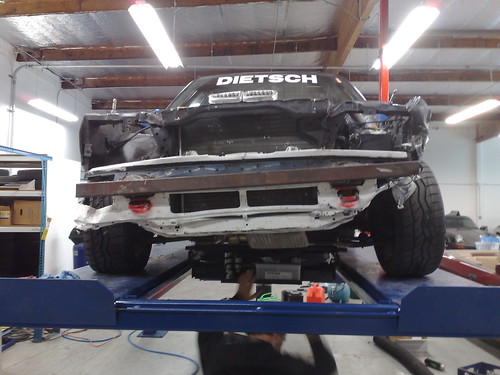
The cage arrived as a set of shaped and welded steel tubes which we painted and left to dry overnight. After that we put the car on the lift at Dietch Werks and got to work fitting in the cage. The back section with the actual roll hoop went in fairly smoothly as did the front windshield bars. The door bars did however cause some interesting issues due to the placement and width of the B-pillar post. The roll cage was designed to fit an E30 coupe since that is the car most commonly used in the Spec E30 class. On a 4 door E30 like ours, the b pillar post is about 8 inches further forward than in the coupe which meant that the main cage roll hoop would not line up with the B pillar. Normally this wouldn’t be an issue (you cant use the back door but that not really a concern in a race car), but since the door bars curve outwards from the roll hoop they were hitting the B-pillar and would not fit in place. The solution was to use a sledgehammer and bend the inner sheetmetal of B-pillar about half an inch outwards. This does affect the structural integrity of the pillar, but since we are doing it to put a full roll cage, the car is going to be considerably stronger than stock.
Before

After - needed to make some space for the door bar

Once the full cage was in place, we drilled holes in the sheet metal and bolted the cage to the car with the included high grade bolts and mounting plates. The final step was to tie the various pieces of the cage using the supplied sleeves which would be bolted across the joints in the cage. This required us to drill a 3/8th inch holes through the sleeve and the cage so we could pass a bolt through. Now this may sound simple but it was actually by far the slowest job. The cage steel is so hard that it takes 10-15 minutes to drill just a single hole and we needed 16 holes in all which meant that it took us a full day just to fit the sleeves. On the plus side though I will feel extremely safe sitting in a car with such a strong cage :-)

Drilling the roll cage mounts

All in all the cage install was a fairly simple process and needed only the most basic tools. It may add weight to the car but in terms of improved safety and chassis rigidity it is one mod that was well worth time, money and effort. If you ever need a roll cage, I strongly recommend buying the Autopower cage from Livermore Performance.

  • Share/Bookmark

Car Prep Day 3 – Its alive

Sunday, October 7th, 2007

Day three of car prep was all about getting the engine running. At this point we had had the car with us for several months but we hadn’t yet heard the damn thing run.

We started up by tightening up the head bolts and putting in a new timing belt. After that we adjusted the valve spacing (space between camshaft and valve stem) and began reconnecting that various fuel hoses and wires. We decided not to put the cooling system in until the engine was in running condition to give ourselves some work room in case we needed to replace any additional parts. After everything was connected back up we added some more oil to the engine and started it for the first time.

It’s Alive from rnair on Vimeo.

After sorting out some initial issues with some blown fuses, the car started on just the second attempt. The cloud of smoke on the side was a combination of an untightened exhaust manifold and some oil burning off. After this major success we decided to wrap up the day and were actually able to drive the car outside to park it. It still doesn’t have a cooling system so we havent run it for any length of time but the fact that it moves under its own power and doesn’t make any weird noises is a great sign.

Baby steps from rnair on Vimeo.

  • Share/Bookmark

Car Preparation – Day 2

Saturday, September 29th, 2007

Day 2 of preparation was all about fixing up the head. As you can see below the valves were in really bad shape and all of them had to be replaced. We cleaned the head and the block before putting on a new head gasket kit.

A very bent valve
Cleaning the underside of the head before putting it back on

The manifolds were bolted back onto the head and we put the head back onto the car. At this point we were feeling quite optimistic about getting the car done when we realized that we didn’t have the right tool to tighten the head bolts – seeing that it was already late we called it quits for day 2 with the head just sitting on the block.

Manifolds bolted back on the head
Put the head back on the block

More photos on Flickr.

  • Share/Bookmark

Car Preparation – Day 1

Friday, September 28th, 2007

Now that we had the car at Dietsch Werks, we had to figure out what was wrong with. Day 1 would be all about stripping the car under Robs guidance. We started out by jacking it up and draining the coolant.

The next step was to remove the cylinder head. This was needed because the 325 is an interference engine and the broken timing belt guarantees that we have belt some valves. We disconnected all the hoses + wiring and used a forklift to lift the head out of the engine bay.

Lifting the head

Once we pulled the head off we made a surprising discovery – all the pistons had valve marks on them. This confused us for a bit until we looked at the timing belt and found that it was not only broken but was also missing several teeth. In a regular timing belt break you usually damage the valves in only one or two cylinders before the engine stops turning and prevents further damage. In this particular instance the engine had kept on running with bad timing (due to the missing belt teeth) and ALL the valves had made at least some contact with the pistons.

Marks from the valves hitting the pistons

While all this work was being done on the engine we got to work stripping the interior of the car and by the end of the day it was looking much more like a racecar.

Looking more like a race car

After this we called it quits for the day and felt quite pleased at having accomplished quite a lot on our first work day.

More photos in my Flickr set.

  • Share/Bookmark

Car Pickup

Friday, September 28th, 2007

After a couple of weeks of frantic paper writing things have finally cooled down enough that I can go back to writing my blog. First on the list is a series of blog posts about our preparation for the 24 hours of Lemons. Sit back and enjoy the fun. :-)

The first and most important thing we needed to run in the Lemons was a car, not just any car, but a car that we’d be able to buy AND prep for for under $500. Looking through the results of the first race we decided that an older japanese econobox would probably be the best car to run with. We were all set to rummage through the local junkyard when fate suddenly dropped a car in our lap. One of Robs friends had an old BMW with a broken timing belt that was blocking his driveway – he told us that as long as we get the car out of his way immediately we could keep the car for free. We quickly showed up at his door to take a look at the car.

We found that the car was a 4 door 1986 BMW 325 E with 245 thousand miles on the clock. The E denoted that it had the economy engine, this meant lower horsepower but higher torque which should be ideal for the tight Altamont circuit. The car itself was in better shape that I expected, the paint was peeling from 21 years of exposure and he interior was a mess but there was very little rust and the engine “looked” ok with the timing belt being the only obvious problem. Being an E30 meant that the parts were cheap and bolt-in rollcages were readily available. People who had entered the last race had warned us that non-running cars were a huge time sink, but the fact that the car was available and free meant that there was only one thing to do. We rolled the car into Robs trailer and made it our official entry into the Lemons race.

More photos of the car pickup in the Flickr set.

P.S.: We are not cheating by getting a “free” car, the KBB value for a 1986 325E in fair condition is $400 – a non-running car is worth almost nothing.
[tags]24 hours of lemons, e30, bmw, 325, preparation, racing[/tags]

  • Share/Bookmark

It’s alive

Wednesday, September 5th, 2007

On Monday we finally got our Lemons car started for the first time – still need to put the cooling system on buts its a relief to finally get it running. I promise I’ll have a series of posts about the actual prep work.

It’s Alive from rnair and Vimeo.

P.S.: The smoke is just oil smoke and the unbolted exhaust – the video got cut off because my phone died on me :(

  • Share/Bookmark

We’re in!

Sunday, August 19th, 2007

I am a huge fan of the 24 Hours of Lemons and am glad to announce that Team SFF1 has officially been accepted into the Arse-Freeze-Apalooza race to be held in Alatamont on 20-21 October. My co-drivers will be Guy Argo, Rob Dietsch, Gabriel Matus and Jyri Virkki. Since we are going to be racing an 1986 MW 325E we decided to go for a BMW F1 based team concept. Check out our accepted team concept and application:

Team Name
SFF1 BMW Sauber

Vechicle Make & model:
2008 BMW Sauber F1.08 aka renovated 1986 BMW 325 E with a broken timing belt and bent valves

Team Concept
After a fast, though unreliable, start to the 2007 Formula 1 championship, the BMW Sauber F1 team has decided that they need additional preseason testing to properly prepare the 2008 F1 car. After developing the initial chassis in secret, the SFF1 test team has been entrusted with performing much needed endurace testing by entering the car in the prestigious 24 hours of Lemons race. With a team of internationally reknowned drivers and backed by a full works pitcrew, the SFF1 team is expected to both compete successfully and gain valuable data to help the car compete for the 2008 F1 season.

Team Drivers
Guy Argo

Guy Argo
In Jim Clark and Jackie Stewart, Scotland has produced two of the greatest drivers to ever race in Formula 1. However after the heady days of the sixties and seventies there haven’t been any true scottish champions – Guy Argo should change all that. He started autocrossing two months after getting his license and one month after taking delivery of his ’92 special edition Mazda Miata. Two months later he won his first autocross. He started indoor go-karting in 2000 and became part of the famous trio (Guy Argo, David Canavan, Paul Smyth) that dominated F1Boston’s indoor racing scene. In 2002 he transitioned to outdoor karts with a sponsored ride for All Kart. He took a brief hiatus after moving to the Bay Area. But as soon as gokartracer.com opened up, he was already making his mark on the Pro League with several podiums and an outright season win. Currently you can find him testing his mettle against all comers atthe Sunday Night Leagues LeManKarting.com in Fremont alongside his protege, Jay Gopal. Reknowned for his patience, cunning and spectacular passing, what he lacks in speed he makes up for in consistency and determination. We await his return to outdoor racing with bated breath.

Robert Dietsch

Robert Dietsch
Rob Dietsch has been involved in motorsport since the late 80′s doing a variety of AutoX and HPDE before graduating to club racing. After winning the SCCA SFR GT4 championship in his rookie year (2003) he progessed to Toyota Atlantic and had a fairly good season before taking a sabbatical from racing. Currently tracking his Lotus Elise and Porsche Cayman at NorCal HPDE, he has been tempted back to the world of competitve motorsport by the chance to go after the ultimate prize – the 24 hours of Lemons.

Gabriel Matus

Gabriel Matus
With the exit of Juan Pablo Montoya, F1 needs another Latin heathrob to bring F1 to Latin America. With his playboy looks and fierce racing determination, Gabriel has all the ingredients needed to become the next Latino Superstar of Formula 1. One of the main organizers behind the SFF1 group, his endurance driving experience includes commuting from San Francisco to Sunnyvale everyday.

Rahul Nair

Rahul Nair
1 billion people and the best India can come up with Narain Kartikeyan??? Rahul Nair expects to redress that balance by merging raw speed with tactical brilliance to become the first Indian to win in F1. This speed freak can spends as much of his life behind the wheel as he can. He has 2 years of HPDE and Autocross experience in his Lotus and is a regular fixture in the bay area go-kart tracks.

Jyri Virkki

Jyri Virkki
Where would any F1 team be without a “Flying Finn”? Jyri brings with him the same ice-cool personality that saw Keke Rosberg, Mika Hakkinen and Kimi Raikkonen win dozens of F1 races and 3 world championships. A Miata addict, he has been running track events since the mid-90s and instructing for about 9 years (currently instructing with Miata clubs, Thunderhill Street School and BMWCCA).

Car Chassis

Before

before
After

after
Pit Crew

Crew chief: Mario Theissen

Mario Theissen
Jack Man: Ron Dennis

Ron Dennis

Communications: Jean Todt

Jean Todt

  • Share/Bookmark

24 Hours of Lemons

Sunday, July 8th, 2007


I’ve been very interested in the 24 Hours of Lemons since I first heard about it last year and when I found out that the first race of the year was this past weekend I just had to go check it out. The Altamont Motorsports Park in Tracy, CA is the home of the race and features two ovals which are interconnected to create a road-course for the Lemons race. The cars all had to be bought and race prepped for under $500 (excluding safety gear) with a team of 4-6 drivers. Despite the name the actual racing would only go on for about 14 hours with a 10 hour break at night to let people recuperate as well as repair their cars.

Wheel of Misfortune
I got there just as the drivers meeting got underway and found that it was pretty well organized. The organizers were very strict about a no bumping/no blocking rule and had come up with a set of humourous punishments for the drivers that broke the rules. The competitors would spin the “Wheel of Misfortune” and have to serve whatever penalty that came up. Some of the penalties included:

  • The Al Gore Carbon Replacement penalty: The competitor would have to wear a tie-die shirt and then plant a rather large sapling in the ground before they could continue.
  • The Colonel Sanders where the participant would be doused in soapy water and then feathered using large pillows.
  • The Legion of Odour involved hanging a half pound of smelly blue cheese around the drivers neck as well as placing another pound of it on the hot intake manifold – should make for a truly odourous experience.
  • The Egg Man winner (or loser) would have an open bucket of eggs welded to the hood of their cars – the idea being that as they drove the eggs would fall out of the bucket and smear the car.
  • My favourite was the Highway 17 penalty where the driver would have to follow a VW microbus around the track for 10 laps.
  • Anyone who bumped other cars on the track would initially have a set of training wheels welded to the sides of their cars
  • Repeat “bumpers” would get the Sword of Damocles penalty where a plate with sharpened spikes would be welded to their radiator with the spikes pointing inwards. At this point they were let out on track knowing that their next bump would be their last.

The organizers required that the drivers have some sort of competition license and the racetrack was more than happy to sell you a NASCAR license at the gate for just $75 dollars. The fact that people could buy licenses at the door was the main factor that dissuaded me from running the Lemons race last year – after all who want to be side by side with a novice driver in a $500 car. However it looked like the penalties did a good job of keeping the track action pretty clean – the serious racer didn’t want to lose the time while the joyriders didn’t want the embarrassment. The speeds are low as well which keeps the event pretty safe. One of the teams was racing an 80′s Golf which went into the tirewall and flipped onto its roof. The track was immediately red flagged and the safety vehicles were at the car in under 5 minutes. The driver was completely unhurt and with the help of the marshal he roled the car back onto its wheels before continuing with the race :-) .

All in all it was a great event and I am seriously trying to get an official SFF1 entry together for the October race (UPDATE: We just got accepted into the October event) – wish me luck. In the meantime you can look at a video I shot as well as some photos of my favourite cars. I have posted the full collection of photos on Flickr though you will probably be better off looking at the excellent photoset that Nithya just posted.

Video of the first few laps of the race:

Shagpile is an excellent aero-aid:

Got Jesus?

The Ford Cow:

Do or Die:

A Japanese Zero:

Squadra Pinto:

  • Share/Bookmark